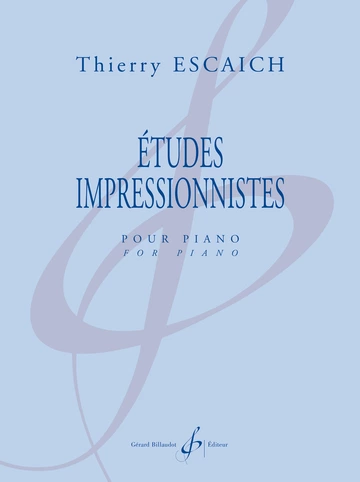
Études impressionnistes
Details
| Instrument family | Piano |
| Catalog classifications | Collection and separate works |
| Instrument nomenclature | piano |
| Total duration | 00:09:10 |
| Publisher | Éditions Billaudot |
| Cotage | GB9394 |
| Musical style | Contemporary |
| Copyright year | 2014 |
| EAN code | 9790043093947 |

Description
Following the cycle of Baroque Studies , written shortly before, these three pieces are as much compositional studies as pieces intended to work on a particular aspect of piano technique.
The first, Intermezzo , is a distant echo of two preludes by Claude Debussy: Bruyères and Général Lavine , from which it borrows some thematic motifs in order to link them. With the help of the piano's third pedal, which allows the hands to be freed while certain sounds or chords remain sustained, we witness a polyphony of textures which often intertwine in an organic flow made of waves, undertows, and fleeting appearances. At times, snatches of Debussy's universe burst in, without ever being true quotations.
The second is more akin to an agitated litany with distantly Gregorian contours. A sinuous and repetitive melody with a shifting rhythm is thwarted by waves of octave chords linked in the left hand. These two contrasting elements generate a polyrhythm throughout a steady and feverish crescendo leading to an abrupt coda.
The third study draws its source from some of Henri Dutilleux's dear sonorities, in homage to whom it was written. The group of chords punctuated by bell sounds that opens the piece bears witness to this. Everything in the rest of the study is a metamorphosis of motifs, a play of harmonic colors responding to each other in various places on the keyboard, multiple echoes... But it is a feeling of luminosity that pervades the whole of this piece, right up to this ample and colorful ending that could be drawn by the verses of Saint-John Perse: "Open doors onto the sands, open doors onto exile, the keys to the people of the lighthouse, and the star broken alive on the stone of the threshold..."
(Thierry Escaich)