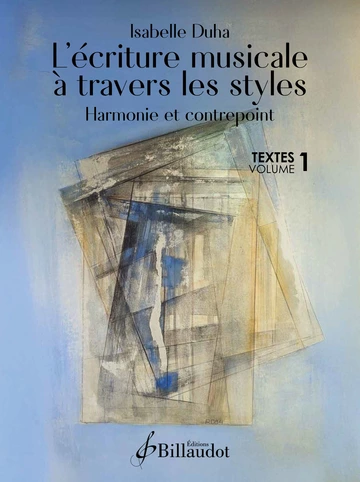
L'Écriture musicale à travers les styles. Vol. 1 - Textes
Harmonie et contrepoint
BAROQUE AND CLASSICAL STYLES
Bass pieces in the style of Bach, Handel, Telemann, Purcell, Beethoven. Melodies for string quartet in the style of Mozart and Haydn.
Elements provided: composition of a minuet in the style of Mozart
Read moreDetails
| Instrument family | Musical training |
| Catalog classifications | Ear training, Harmony / Improvisation |
| Instrument nomenclature | formation musicale : textes d'écriture |
| Publisher | Éditions Billaudot |
| Cotage | GB10720 |
| Total number of pages | 72 |
| Languages | French, English |
| Cycle / Level | Difficult (cycle 3) |
| Copyright year | 2025 |
| EAN code | 9790043107200 |

Description
Welcome to the First-Year Music Composition Handbook.
The first exercises address 3- and 4-part chords (dominant 7th), and include no harmonic notes, such as suspensions, passing notes, neighbor notes, appoggiaturas and anticipations. The advantage of this approach is that it gives students the opportunity to harmonize bass lines and melodies in different styles right away, respectively Baroque and Classical, thus enriching their experience. For three-part chords (5, 6 and 6 4) and four-part chords (dominant 7th), see the factsheets in my harmony and counterpoint at the keyboard method Le langage musical en liberté (Éditions Billaudot).
Memorizing and transposing the numerous examples of cadences and harmonic sequences provided will help students realize the exercises directly at the keyboard.
For more effective harmonic ear training, I recommend studying harmony and counterpoint at the keyboard right from the start. Switching from keyboard to paper and vice-versa always proves fruitful and interesting. Memorize the realization at the keyboard first, then write it down, and finally transpose it - first at the keyboard then in writing. It is a great way to develop one’s skills, speed and quickness.
Once you’re familiar with this method, you are ready to work on this first volume.
For clarity’s sake, all realized examples and exercises are analyzed.
