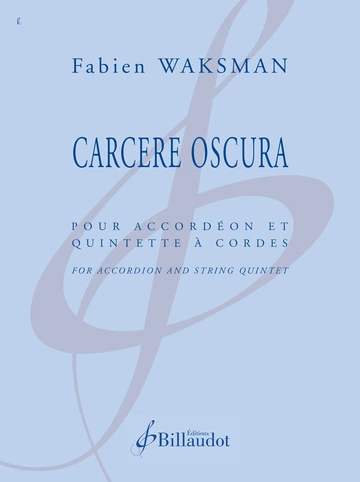
Carcere Oscura
Details
| Instrument family | Accordion, Chamber music |
| Catalog classifications | Accordion and orchestra or ensemble, Sextets |
| Instrument nomenclature | accordéon et quintette à cordes |
| Total duration | 06:50:00 |
| Publisher | Éditions Billaudot |
| Cotage | GB10373 |
| Total number of pages | 86 |
| Languages | French, English |
| Cycle / Level | concert |
| Target audience | Young people, Adults |
| Musical style | Contemporary |
| Directory type | Original work(s) |
| Copyright year | 2022 |
| EAN code | 9790043103738 |
| Audios | Without |
| Videos | Without |
| EDU complements | Without |

Description
What can hearing loss mean for a composer? This is the question I tried to answer by composing this sextet, written in homage to Beethoven. The image of Beethoven imprisoned in his own body was the starting point for this piece. A prison of Dantesque proportions, both immense and oppressive. This inner world, which I imagine to be the mind of a Beethoven without auditory contact with the outside world, reminded me of Piranesi's engravings. Carcere Oscura, created in 1743, constitutes a prelude to the cycle of Carceri d'Invenzione, the artist's masterpiece. This prison universe has a fantastic aspect due to its monumental character. It nevertheless remains forever closed, inhuman, and therefore terribly frightening. In the words of Marguerite Yourcenar, the Carceri evoke a "fictitious world, yet sinisterly real, claustrophobic, yet megalomaniac (which) is not without reminding us of the one where! “Modern humanity is closing itself off more and more every day.” The famous opening motif of Beethoven’s Fifth Symphony runs through the entire piece. Its treatment is most often frenetic, as if he seemed to be running desperately through a constantly evolving labyrinth in search of an exit, a comfort, a glimmer of light. Although the setting changes considerably, the sense of urgency rarely leaves a discourse in which the accordion gradually manages to gain its independence from a very dense and compact string ensemble. After the appearance of a new cell from the second theme of the Fifth Symphony, calm gradually appears, all traces of panic disappear, the music becomes more floating and meditative: it is time for Beethoven to go within himself, to seek other paths to find the strength to overcome the ordeal of his deafness. Suddenly, the frenetic pulse becomes omnipresent again, as if Beethoven had become aware of his capacity to transcend and was eager to get back to work. Rage here is no longer synonymous with despair, but with impatience. The accordion, carried by obsessive strings hammering out the motif of the Fifth Symphony, seems to be hurtling towards the exit of the labyrinth, like Beethoven towards his future masterpieces. The composer triumphed over his prison and will forever remain for us an example of the human capacity to surpass oneself during the trials of Life.