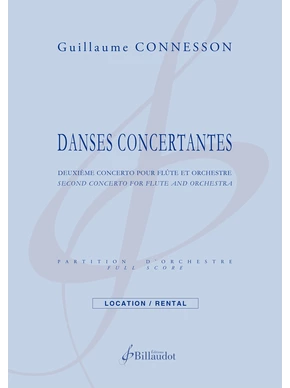
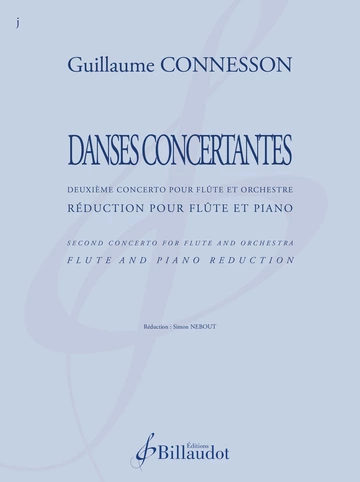
Danses concertantes
Deuxième concerto pour flûte et orchestre
Danses concertantes, the second concerto for flute and orchestra by this composer, is presented as a suite of seven dances, namely four fast movements framing three slow movements (a theme followed by its two variations).
Read moreDetails
| Instrument family | Flute |
| Catalog classifications | Flute and piano |
| Instrument nomenclature | flûte et piano (réduction) |
| Total duration | 00:22:30 |
| Publisher | Éditions Billaudot |
| Cotage | GB10700 |
| Total number of pages | 80 |
| Languages | French, English |
| Cycle / Level | concert |
| Musical style | Contemporary |
| Directory type | Original work(s) |
| Copyright year | 2025 |
| Year of composition | 2024 |
| EAN code | 9790043107002 |

Description
Guillaume Connesson wanted to compose a highly dynamic and virtuosic music, where the spirit of dance – even in the slow movements – is ever-present. Unlike his first concerto with its extensive instrumentation, this one is orchestrated for a "Mozart" ensemble with the addition of a percussionist, which inspired him to seek out clear and transparent colors.
The first dance begins immediately with the exposition of a grand, ten-measure theme in a leaping C major. Frank and sunny in character, this theme will be developed on a constant pulse throughout the entire movement.
The second dance is the exposition of a youthful theme that will be transformed in the two other slow movements. Presented in the soloist's high register over a rhythmic ostinato on pedal, it unfolds like a pure lyric.
The third dance is a scherzo, in the form of a study in lightness, in a 6/8 rhythm. In the middle, in a sort of trio, a pianissimo passage is indicated "as smooth as velvet", before the resumption of the scherzo.
With the fourth dance, "Tango Macabre," a true shift in character occurs in the work. A variation on the theme of the second dance, it is a tense and dramatic tango, beginning after a short, slow introduction. The tempo gradually accelerates, the tension building until it becomes a cry in the treble register of the flute. Towards the end, the rhythm disintegrates, consumed by silences, and an enigmatic coda concludes the movement.
The fifth dance is in 11 beats. After a furioso introduction (which also serves as the coda) by the orchestra, the rhythmic ostinato begins in the flute. In the central section, a highly lyrical theme unfolds in the strings, but always within the same rhythmic framework.
The sixth movement explores the soloist's lower register and its gentle intimacy. It offers a variation on the theme of the second movement, but with a new shift in character. Becoming melancholic, the line rises to a cry of despair before quickly falling back into the lower register.
It is in this same somber register that the finale, the seventh dance, begins. This is the only movement that features such tempo changes, starting in moderato and ending in presto. Two themes, one robust, presented by the flute, and the other highly lyrical, played by the violins, combine during the development section. After a brief lull, the concerto concludes in an explosion of frenetic joy (based on the transformation of the second motif).