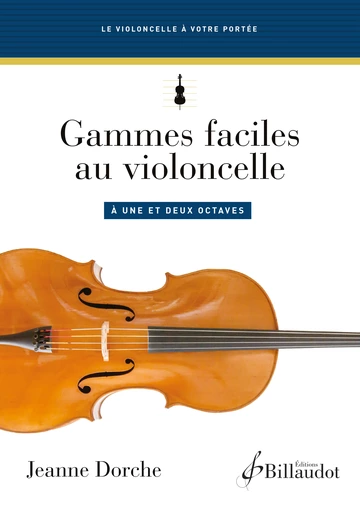
Gammes faciles au violoncelle à une et deux octaves
Scales are an essential component of learning the cello, regardless of your age, level, or goals. In this clear and simple book, we wanted to offer a practical and accessible tool for those who are just starting out on the instrument.
In this collection, you will find 24 major and minor scales. Each scale is first presented over one octave, then the same scale is developed over two octaves. Next, a third variation over two octaves, as well as the corresponding arpeggio, are offered to complete your work.
A must-have for all cellists!
Details
| Instrument family | Cello |
| Catalog classifications | Studies |
| Instrument nomenclature | violoncelle |
| Publisher | Éditions Billaudot |
| Collection | Le violoncelle à votre portée |
| Cotage | GB10559 |
| Total number of pages | 52 |
| Languages | French |
| Cycle / Level | Easy (cycle 1) |
| Target audience | Children, Young people, Adults |
| Musical style | Classical |
| Copyright year | 2023 |
| EAN code | 9790043105596 |
| Audios | Without |
| Videos | Without |
| EDU complements | Without |

Description
Scales are an essential component of learning the cello. They are essential, regardless of your age, level, and goals. Scales have only advantages. They offer you an effective warm-up, which prevents the development of tension and pain. They allow you to establish a well-positioned left hand, with stable tuning. They constitute a training ground, for any technical difficulty you wish to work on. Finally, working on scales will allow you to familiarize yourself with the keys encountered in the pieces. We wanted to maintain the clarity and simplicity of a book of scales for beginners. In this collection, you will find 24 major and minor scales. Each scale is first presented over one octave, then the same scale is developed over two octaves. Then, a variation of the third over two octaves, as well as the corresponding arpeggio, are offered to complete your work.