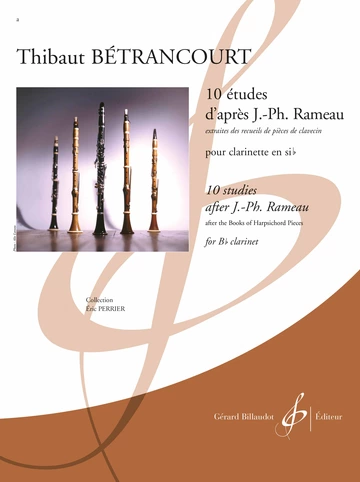
10 Études d’après Jean-Philippe Rameau
Details
| Instrument family | Clarinet |
| Catalog classifications | Solo B-flat clarinet |
| Publisher | Éditions Billaudot |
| Collection | PERRIER Eric |
| Cotage | GB10212 |
| Total number of pages | 32 |
| Cycle / Level | Difficult (cycle 3) |
| Target audience | Adults |
| Copyright year | 2020 |
| EAN code | 9790043102120 |

Description
Rameau transcribes for the clarinet! A surprising choice perhaps, but interesting in many ways. While Johann Christoph Denner's clarinet, which appeared around 1690, was a very young "prototype" instrument for composers of the Baroque era, it was Jean-Philippe Rameau who introduced this instrument to the orchestra in his fourth tragédie lyrique Zoroastre in 1749.
When the idea came to me to look at this repertoire, perhaps unknown to clarinettists, Rameau's pieces immediately seemed interesting and suitable for transcription.
These 10 studies after Jean-Philippe Rameau, taken from the collections of harpsichord pieces from 1724 and 1726/1727, have a primarily educational objective; they will allow an apprenticeship in Rameau's style in particular and French Baroque music in general, notably through specific work on the ornamentation and articulation of this period through character pieces.
The metronome markings, dotted articulations, and ossia in La Villeroy are suggestions, with the understanding that for this music, a certain freedom is left to the performer. The nuances are also the musician's choice, since these are adaptations of harpsichord pieces.