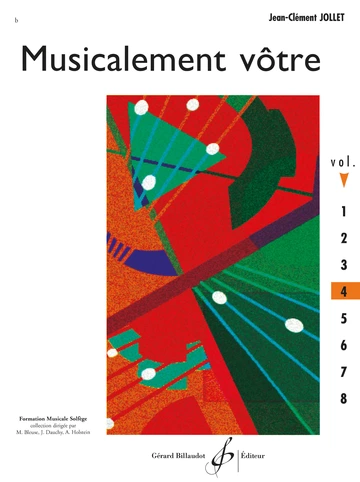
Musicalement vôtre. Volume 4
Prepare reading reflexes for a calm handling of the instrument
Musically Yours is the music theory method that appeals to both music teachers and instrumental teachers. Focusing on developing instrumental reading reflexes, this method combines excerpts from a variety of repertoire with melodic exercises designed to be played or sung.
Read moreDetails
| Instrument family | Musical training |
| Catalog classifications | Note and rhythm reading |
| Instrument nomenclature | formation musicale |
| Publisher | Éditions Billaudot |
| Collection | Formation Musicale Solfège (F.M.S.) |
| Collection management | HOLSTEIN Aline, DAUCHY Jacques, BLEUSE Marc |
| Cotage | GB5676 |
| Total number of pages | 64 |
| Languages | French |
| Cycle / Level | Moderately difficult (cycle 2) |
| Target audience | Adults, Children, Young people |
| Directory type | Work(s) from the repertoire |
| Copyright year | 1998 |
| EAN code | 9790043056768 |
| Audios | Without |
| EDU complements | Without |
| FM-specific content | Melodic instrumental application, Rhythmic instrumental application, Note reading, Rhythm reading, Polyrhythmic reading, melodies |

Description
Volume 4 of the Musicalement vôtre series, developed by Jean-Clément Jollet, continues the acquisitions of the previous levels through musical examples, as well as technical exercises optimized for the level in question and for reading notes, he will discover the C 3 clef, that of the viola, which he will frequently find in his future scores. Each volume is made up of two parts: when a concept is taught in the 1st part, the student will find it later in the second part presented this time differently in other forms. These different reading exercises lead to several musical examples to illustrate more concretely the concepts acquired through the lessons.