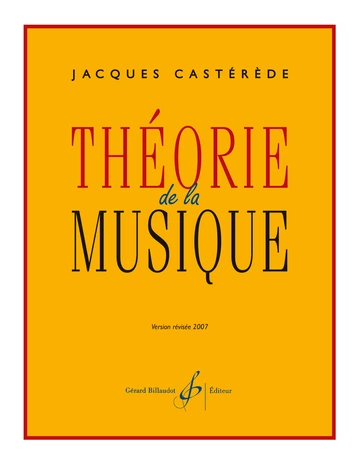
Théorie de la musique
Details
| Instrument family | Musical training |
| Catalog classifications | Analysis / Theory |
| Publisher | Éditions Billaudot |
| Cotage | GB6163 |
| Total number of pages | 304 |
| Languages | French |
| Target audience | Adults, Teacher |
| Directory type | Work(s) from the repertoire |
| Copyright year | 1999 |
| EAN code | 9790043061632 |
| Audios | Without |
| EDU complements | Without |
| FM-specific content | Theory and analysis |

Description
In this Théorie de la musique , one will of course find all the information that appears in any complete theory, on notation, meter and rhythm, intervals, tonality, etc., but here, each chapter is followed by a commentary entitled “To find out more”, which explains the reasons, historical or technical, which have led to the rules and habits currently in force in Western music.
An important appendix deals with subjects that a traditional theory does not generally address, such as Gregorian notation, medieval modality, or even new techniques and signs that appeared in the 20th century: diatonic and chromatic modality, dodecaphonic serialism, aleatoric music, special notations, guitar notation in jazz.
The whole is illustrated with numerous examples borrowed from classical or contemporary composers.