Choral's dream
Details
| Instrument family | Chamber music |
| Catalog classifications | Duets |
| Instrument nomenclature | piano et orgue |
| Total duration | 00:12:00 |
| Publisher | Éditions Billaudot |
| Cotage | GB7175 |
| Cycle / Level | concert |
| Musical style | Contemporary |
| EAN code | 9790043071754 |
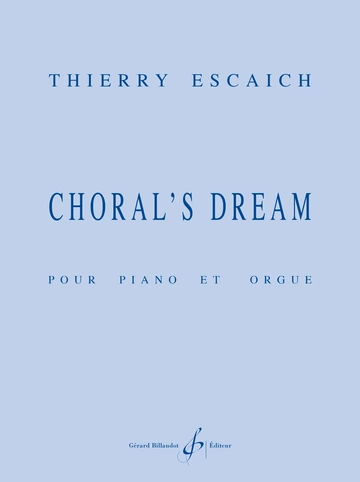

Description
> Commissioned by the Monte-Carlo Spring Arts Festival
> Premiere on May 11, 2001, in the Salle des Variétés (Monaco), by Claire-Marie Le Guay (piano) and Thierry Escaich (organ)
---
Piano and organ, the alliance is not easy. Thierry Escaich knows this repertoire well, having played it regularly with pianist Claire-Marie Le Guay – who inspired the composition of Choral's Dream . He also knows its limits: the distance that often separates the organ loft from the piano, and requires performers to pay increased attention to the intentions and breathing of a partner they often do not see; and above all the antagonistic nature of two instruments that a priori have nothing in common. "Each," explains the composer, "is an orchestra in its own right, but in its own way: one with its richness of colors and planes, the other with its sonic fullness and flexibility. To combine them, you have to make them move towards each other, find convergences."
Until then, the rare works written for this formation fell into two broad categories: the scores of Widor, Franck, or Saint-Saëns, intended for salon organs, or even harmoniums, where one instrument is often confined to accompanying the other; and the more recent ones by Langlais, Dupré, or Guillou, designed for powerful organs and conceived more like battles between titans. Neither of these two perspectives appealed to Thierry Escaich. He therefore sought his own path, continuing the research into fusion between timbres that he had been pursuing for several years in his pieces with organ but more generally in his entire work – with magnificent peaks in the oratorio Le Dernier Évangile (1999) and the Chaconne for orchestra (2000).
Choral's Dream is resolutely symphonic, in the sense that the instrumental formation bends to the subject – and not the other way around – and where the enemy brothers are called upon to join forces, to sublimate one another, instead of subjugating or opposing one another. The piano enlivens the inert sound of the organ, with its arpeggios and pearly features. Conversely, the organ prolongs the resonances of the piano, enveloping it with its broad spectrum thanks to its highest and lowest stops; its background and undulating stops bring foundation and mellowness to the more percussive sounds of the piano.
The fusion between the two instruments is illustrated from the first bars, where the harmonies of the organ slip into the sonorous halo of the piano and emerge from it in turn. The atmosphere of the work is immediately established: dreamlike, bathed in a soft light. The first theme heard in this "Choral Dream" is Aus tiefer Not schrei ich zu Dir : the Lutheran equivalent of the Catholic De profundis , namely Psalm CXXX, an anguished plea of the believer to his creator ("From the depths I cry to you, Lord..."). But, presented thus in the high register of the piano, bathed in pedal, this theme is dispossessed of its tragic character; the composer uses it not for its dramatic content, but for the musical perspectives offered by its melody. Two motifs emerge from it: the initial leap of fifths, descending then rising to the starting point ( D – G – D ), and the sinuous figure that follows ( D – E- flat – D – C – D ). Each of these motifs will irrigate the work in its own way, without interruption, until the final bars. The back and forth of fifths generates the first organ chords; it will regularly punctuate the discourse, dreamy or brutal, constricted or dilated, in unison or carried by chords, but always recognizable. As for the sinuous figure, it takes flight, transforms into volutes of eighth notes, takes on accents of light dance, explodes into convulsive snatches, becomes a cavalcade, impetuous waves, swells of chords, tempestuous ostinato of the pedalboard, ecstatic arpeggios…
Meanwhile, another Lutheran chorale appeared. In the first third of the work, the Cromorne's raucous voice intoned Herzliebster Jesu, was hast du verbrochen? ( Jesus, beloved with all your heart, what evil have you done? ), a chorale that Bach harmonized in several guises in his Passions and on the organ. Thierry Escaich, who explored it in numerous improvisations, delivers a tormented version here: insistent recto tono , choppy rhythm, nervous flourishes. The elements from this theme in turn enter the round, confronting the initial motifs in a complex and increasingly vehement polyphony where, behind the gushing and exalted aspect, nothing is left to chance.
As is often the case with Escaich, the dream turns into a nightmare; the original distress of Aus tiefer Not , long kept at bay, finally bursts forth. But here, unlike so many of his works, the author finds peace. A swirling piano motif, in the high register, sounds the armistice; it gradually deflates, while the high flute of the organ (Flute 4') enters on tiptoe and gradually envelops it, until a superb modulation underlined by the trembling of a long chord on the Voix céleste (playing with undulating effects). In this unreal glow, the organ twice pronounces Aus tiefer Not, completely defused. Then the light begins to scintillate, under the effect of the organ's highest playing (Piccolo 1'). We then hear, in the high notes of the pedalboard (Flute 4'), the third chorale theme: Wie schön leuchtet der Morgenstern ("How beautiful is the light of the morning star"); its clear contours of a major perfect chord definitively reassure the listener, who slides gently, in its company, towards the peaceful and ultimate echoes of the motifs heard previously.
(Claire Delamarche)