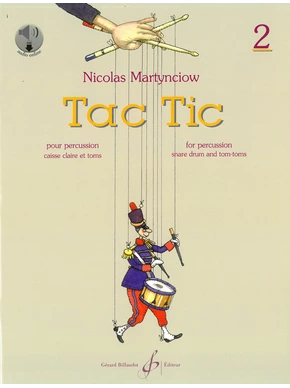
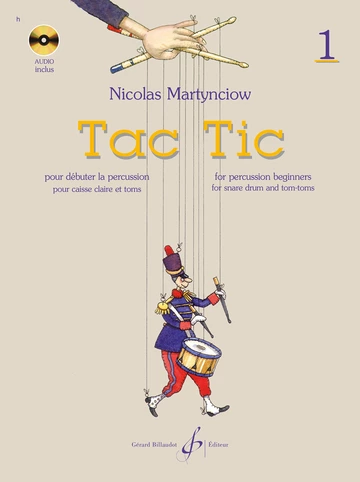
Tac Tic. Volume 1
Start percussion with a fun method
Tac Tic offers a unique way to learn percussion by achieving a regular beat and developing coordination. It combines rhythmic language with simple onomatopoeia that promotes learning. A snare drum and two toms are all you need to acquire new knowledge in each lesson: exercises, small studies, and duets. A CD accompanies the student's personal work.
Details
| Instrument family | Percussions |
| Catalog classifications | Methods |
| Instrument nomenclature | percussion |
| Publisher | Éditions Billaudot |
| Collection | Les Percussionnistes |
| Collection management | MARTYNCIOW Nicolas |
| Cotage | GB7509 |
| Total number of pages | 64 |
| Languages | French, English |
| Cycle / Level | Beginner, Easy (cycle 1) |
| Target audience | Children, Young people, Adults |
| Copyright year | 2004 |
| EAN code | 9790043075097 |
| Audios | Audio CD, on Education area |
| Videos | Without |

Description
Tac Tic is a method designed for students who are just starting out on percussion. Dedicated to the progressive study of rhythms and their different fingerings, it is associated with the learning of a rhythmic language using simple onomatopoeia. A snare drum is provided for this purpose, of course, but also two toms which give a more playful side to the method. Each lesson, aimed at acquiring new knowledge, is mainly made up of exercises, small studies and duets, represented by means of pictograms presented in the glossary. The exercises and studies are first played on the snare drum alone, then the toms are added in a second version where rhythms and fingerings remain unchanged. The teacher or a higher-level student accompanies the duets. As for the CD, in principle reserved for personal work, it gives the opportunity to work on each duet in three different tempi: a first, quite slow; a second, faster; and finally a third, fast. Those indicated at the beginning of the duet correspond to the two fastest. Each new rhythm covered during a lesson is perfected through a study to sing and/or play, called: rhythm. The small turns are rhythmic cells to be repeated in a loop in order to obtain a regular pulse and a good "feel". Finally, short coordination exercises offer an opening onto the study of the drums. This is also why the toms are arranged: high, facing the snare drum; low, to its right.