A tempo : écrit. Volume 9A
Cours de formation musicale
The ideal teaching of musical training
Twelve lessons with varied exercises, presented as songs, traditional music, or excerpts from classical works: A Tempo offers a lively method for teaching music theory. This written volume, with its thoughtful pedagogy and clear presentation, is suitable for both children and adults.
A playlist on the Deezer, Spotify and Qobuz platforms is available on the publisher's education section: https://edu.billaudot.com.
Read moreDetails
| Instrument family | Musical training |
| Catalog classifications | Complete courses |
| Instrument nomenclature | formation musicale |
| Publisher | Éditions Billaudot |
| Collection | GAULTIER Emmanuel |
| Collection management | GAULTIER Emmanuel |
| Cotage | GB9509 |
| Total number of pages | 68 |
| Languages | French |
| Cycle / Level | Difficult (cycle 3) |
| Target audience | Adults, Young people |
| Directory type | Work(s) from the repertoire |
| Copyright year | 2016 |
| EAN code | 9790043095095 |
| Audios | on Education area |
| EDU complements | Without |
| FM-specific content | Harmonic listening, Melodic listening, Rhythmic listening, Theory and analysis |
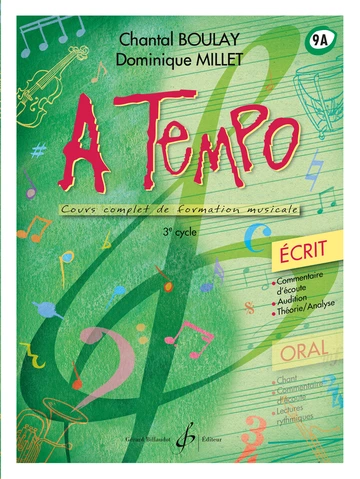



Description
Since the FM course in postgraduate studies often takes place over two years, we offer two series, 9A and 9B, each designed with an “Oral” volume and a “Written” volume.
Series 9A and 9B are entirely different in content, but cover similar concepts.
In this volume 9A “Written” you will find:
• 6 chapters, each developed around one or more works by a composer.
• A summary chapter at the end of the book summarizes all the acquisitions of the year.
Each chapter offers listening commentary activities, melodic, rhythmic or harmonic dictations in different forms, as well as notions of theory or analysis.
The pages with a white background correspond to individual work; these activities can be done collectively in class.
Beyond the extracts included in the book, we encourage teachers and students to consult the original score in order to extend their study.
As in previous volumes, these excerpts are numerous, intended to encourage the exploration of diverse repertoires. However, due to difficulties in obtaining reproduction rights for some 20th-century composers, we were unable to publish certain excerpts from copyrighted works.