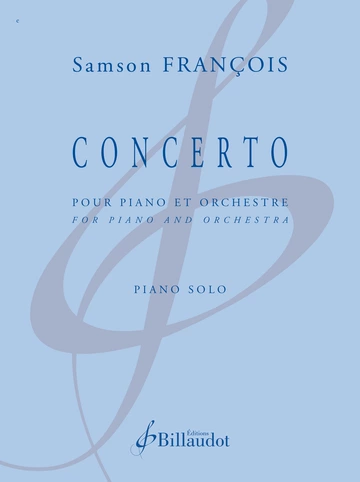
Concerto
This major work by Samson François develops a very personal aesthetic, which is not that of the classical concerto. "The real influence on his writing is that of jazz. It's a kind of improvisation of both piano and orchestra."
This concerto has not been performed in concert since 1951. The only recording is that of Samson François and Georges Tzipine in 1953.
(Score and orchestral equipment for hire)
Details
| Instrument family | Piano |
| Catalog classifications | Collection and separate works |
| Total duration | 00:25:00 |
| Publisher | Éditions Billaudot |
| Cotage | PN6130 |
| Total number of pages | 44 |
| Cycle / Level | concert |
| Target audience | Adults |
| Copyright year | 2022 |
| EAN code | 9790043928935 |

Description
Samson François premiered his concerto on July 24, 1951, at the Aix-en-Provence Festival*, with the orchestra of the Société des Concerts du Conservatoire, under the direction of Ernest Bour. The same year in Paris, he performed it with the same orchestra, conducted by Georges Tzipine, to whom he wrote: "I owe you one of the most beautiful memories of my life as an artist..."*
A major work by Samson François, composed of two linked parts, it develops according to a very personal aesthetic that is not that of the classical concerto. "The real influence concerning his writing is that of jazz. It does not have a concerto form strictly speaking, it is a kind of improvisation of both the piano and the orchestra."*
The piano writing, in fusion with the colors of the orchestra, exploits to the maximum the sonic and technical possibilities of the instrument. We feel the mark of a musician in full maturity, who plunges us into a sonic alchemy. It leaves the performer a great freedom of expression. For Samson François: "The piano is not the noblest instrument in the world, but the most essential." Here, it becomes an outlet; the composer dialogues with himself and reveals his moods to us.
This piano concerto has not been performed in concert since 1951. The only recording available for disc is that of Samson François and Georges Tzipine in 1953. As such, this edition has a historic significance. I am particularly pleased to support it in order to bring the work to the attention of as many people as possible.
Frédéric Demoulin
* Book by Maximilien François: Samson François, Stories of... A Thousand Lives, Éditions Bleu Nuit Éditeur, France, 2002.
All quotes are from Samson François.
Sheet music and orchestral equipment for hire.