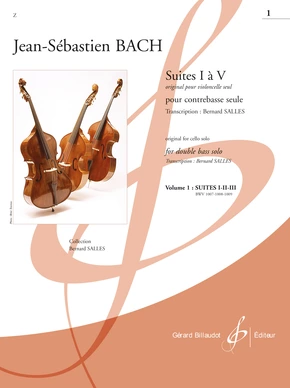
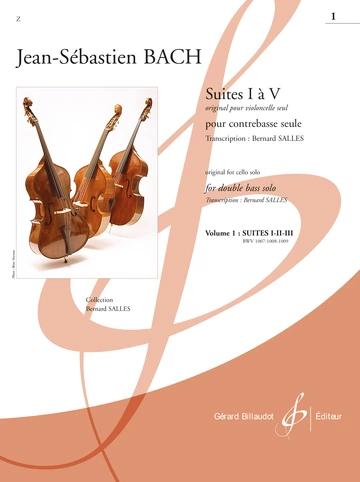
Suites I-II-III
BWV 1007-1008-1009
These very famous Suites were originally written for the cello, without knowing the exact purpose for which BACH wrote them: concert or didactic purpose in the form of studies...
Bernard Salles studied these Suites in various existing transcriptions and decided to present all the Suites in the same key of G, that of the first Suite. For the latter, the "orchestral" tuning of the double bass is retained; for the other Suites, "scordatura" is recommended, a common practice in BACH's time, which makes the Suites "sound" in A instead of G and ostensibly brings them closer to the original pitch.
As far as possible, the bow strokes proposed in the manuscript by Anna Magdalena BACH have been respected (those proposed are in gray) and the fingerings studied so as not to hear the "de-handling" too much, hence the use of extended fingerings at the bottom of the neck (swan neck) which do not present any particular difficulty, even for small hands.
Read moreDetails
| Instrument family | Double-bass |
| Catalog classifications | Double-bass solo |
| Instrument nomenclature | contrebasse seule |
| Total duration | 01:07:30 |
| Publisher | Éditions Billaudot |
| Collection | SALLES Bernard |
| Collection management | SALLES Bernard |
| Cotage | GB6802 |
| Total number of pages | 28 |
| Languages | French, English |
| Cycle / Level | Difficult (cycle 3) |
| Musical style | Baroque |
| Directory type | Work(s) from the repertoire |
| Copyright year | 2004 |
| EAN code | 9790043068020 |

Description
These very famous Suites were originally written for the cello, although no manuscript in BACH's own hand has survived. Only two copies are known to date: the manuscript by Anna Magdalena BACH, dating from the 1730s, whose calligraphy is very close to the master's handwriting (some musicologists even believe that only the title page is in Anna Magdalena's hand, which would make this score a true original...), and the much lesser-known one, with more variants, by a pupil of BACH: Johann Peter KELLNER, organist, dating from 1726.
We still do not know for what exact purpose BACH wrote these Suites: concert or didactic purpose in the form of studies ... During the "return to BACH" in the 1820s, under the impetus of Felix MENDELSSOHN, the Suites for solo cello were quickly published, but only for pedagogical purposes, just like the Partitas for solo violin or the books of the Well-Tempered Clavier. It was necessary to wait for the "rediscovery" of these Suites by Pablo CASALS around 1920 and his performances in concert or on records for them to achieve the status of a musical work in their own right and thus enter the repertoire of all cellists. The same is true for the double bass: BACH's work includes a significant portion of pieces of a didactic nature, and it can be said without much risk that BACH is the greatest teacher in the history of music. Thus all the instruments whose tessitura is close to that of the cello have taken hold of these Suites to work on them in the form of studies.
I have therefore studied these Suites in different transcriptions without finding the transcription and range that suits or seems suited to the double bass. Either transcriptions that are too low, which respect the original key by transposing it by an octave, or transcriptions that are too high (except for the first Suite) which have the merit of playing these Suites in the original key and range but (from the second Suite onwards) have the double bass playing in an extremely high range that does not seem to me to correspond to the volume of the sound box of this instrument. Or finally, fanciful transcriptions where keys, notes and rhythms are changed without providing a technical facility that allows for a coherent musical interpretation. In order not to spend my life working on them in all sorts of keys, I decided, after various experiments and tessitura tests, to play all the Suites in the same key, namely G, the key of the first Suite which is no more difficult to play in the real tessitura than in other keys, because it was written relatively low for the cello.
One could criticize the non-respect of the original tonalities: I understand in fact that if BACH chose such and such a tonality it is because it corresponded in his internal hearing to a very particular "color". But then we must also address the problem of the pitch. We know that in BACH's time it was far from being fixed and differed according to the countries and even the courts, not to mention the pitch of the Chapel (church) and the pitch of the Chamber (Court) which could be different in the same city! It is commonly accepted today that the pitch at the time of BACH was about a half-tone below the current pitch: it would therefore be necessary to play the first Suite in F# major instead of G, the second in C# minor instead of D. etc ... or more simply to do as the baroque interpreters: to play at the pitch of the time, that is A = 415 instead of 440.
The first Suite in the original key keeps the "orchestral" tuning of the double bass; for the other Suites, I recommend the "scordatura" practice common in BACH's time which consists of changing the tuning of the instrument, using the "solo" tuning a tone above the traditional tuning (F-B-E-A) which makes the Suites "sound" in A instead of G and brings them ostensibly closer to the original pitch.
Once the problem of tessitura and pitch has been "resolved", the equally delicate issue of bow strokes and fingering remains, in order to make these Suites "audible" to the public in concert or recording, and to remove them from their purely educational purpose.
As far as possible I tried to respect the bow strokes proposed in the manuscript of Anna Magdalena BACH (bow strokes marked in solid lines; those that I propose are in gray) and to find, in relation to these bow strokes, fingerings which allow not to hear the "de-handling" too much, hence the use of extended fingerings at the bottom of the neck (swan neck) which do not present any particular difficulty, even for small hands.