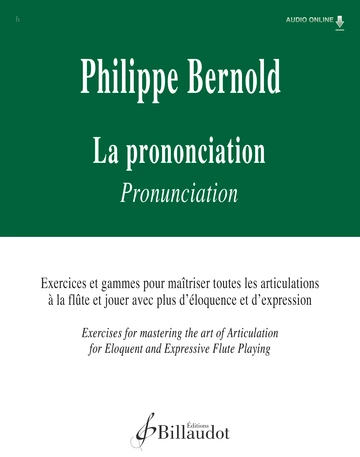
La Prononciation
Exercices et gammes pour maîtriser toutes les articulations à la flûte et jouer avec plus d’éloquence et d’expression
Articulation is a fundamental element in flute playing. Mastering it allows for a clear, varied, colorful, and therefore lively discourse. This workbook aims to deepen these numerous possibilities of expression by drawing on two series of scales and various orchestral exercises and passages.
Read moreDetails
| Instrument family | Flute |
| Catalog classifications | Studies, Methods |
| Instrument nomenclature | flûte |
| Publisher | Éditions Billaudot |
| Collection management | BERNOLD Philippe |
| Cotage | GB10000 |
| Total number of pages | 100 |
| Languages | French, English |
| Cycle / Level | Difficult (cycle 3) |
| Target audience | Young people, Adults, Teacher |
| Musical style | Classical |
| Directory type | Original work(s), Work(s) from the repertoire |
| Copyright year | 2021 |
| EAN code | 9790043100003 |
| Audios | Without |
| Videos | Without |
| EDU complements | Without |

Description
Articulation, pronunciation, is a fundamental element in flute playing. Mastering it allows us to have a clear, varied, colorful and therefore lively speech. Articulation on the transverse flute is done by cutting the sound with the tongue, like a singer cuts a melodic line with words. This workbook aims to deepen these numerous possibilities of expression by relying on two series of major and minor scales, but also by addressing numerous exercises and orchestral passages. The work is divided into six chapters: — The first chapter deals with the connection between breath, tongue and fingers on major and minor binary scales and on major ternary scales with reduced ambitus (level 1 scales); — The second chapter focuses on the place of the tongue. Through exercises often taken from the repertoire, the study of the "French" detached is addressed here; — The third chapter explores all the articulations on a new series of major and minor binary scales (level 2) with a larger ambitus; — The fourth chapter is intended to improve the speed of the double and triple tongue stroke - the fifth chapter deals with the different modes of attack of sounds; — The sixth chapter presents the main orchestral traits, as well as a complementary study where articulation is the main difficulty. At the end of the volume, you will find a chapter entitled "Notes for the curious!" made up of in-depth articles as well as a paragraph on articulation through teaching methods from the 17th to the 20th century.