Le Souffle, le son
Exercices, extraits d'œuvres du répertoire destinés à maîtriser la colonne d'air de la flûte et acquérir un beau son
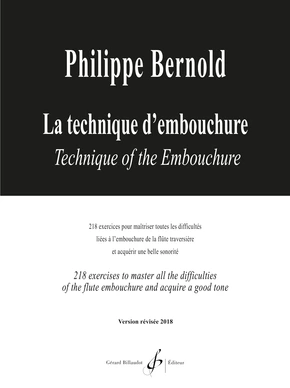
Le Souffle, le son is a workbook that extends the knowledge acquired in La Technique d'embouchure, the successful method of Philippe Bernold, professor at the CNSM. In a playful format, it offers exercises mostly taken from works from the solo, chamber, and orchestral repertoire, which he explores in light of his teaching experience.
Read moreDetails
| Instrument family | Flute |
| Catalog classifications | Studies, Methods |
| Instrument nomenclature | flûte |
| Publisher | Éditions Billaudot |
| Collection management | BERNOLD Philippe |
| Cotage | GB9708 |
| Total number of pages | 80 |
| Languages | English, French |
| Cycle / Level | Moderately difficult (cycle 2), Difficult (cycle 3) |
| Target audience | Young people, Adults, Teacher |
| Musical style | Classical |
| Directory type | Work(s) from the repertoire |
| Copyright year | 2016 |
| EAN code | 9790043097082 |
| Audios | Without |
| EDU complements | Without |

Description
Le Souffle, le son is an exercise book that extends and amplifies the work covered in La Technique d'embouchure, a highly successful work. Philippe Bernold, professor at the Conservatoire National Supérieur de Musique de Paris, offers new exercises in a very playful format, most of which are based on works from the solo, chamber and orchestral repertoire (with more than twenty excerpts) by Bach, Mozart, Bizet, Reinecke, Prokofiev, Debussy, Dutilleux, Messiaen, etc. It includes new vocalizations, fundamental exercises for working on the base of the air column and the energy of the breath, and will address the work of the embouchure and the ends of phrases using harmonic sounds. The length of the breath and legato are two new chapters that allow the flautist to play with an expression comparable to that of singers. Finally, the last part deals with such fundamental subjects as support, vibrato, the air column, jaw movement, timbre, nuances... in the form of articles that this remarkable flautist and teacher, heir to the French flute school, explores in the light of his teaching experience.