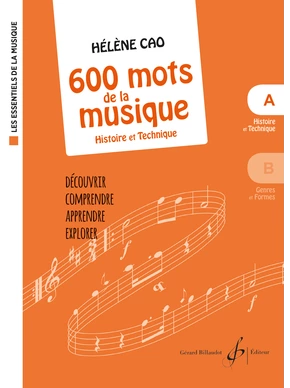
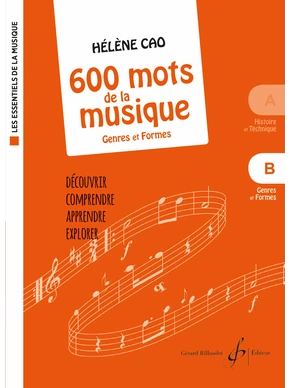
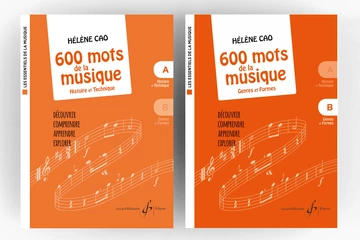
600 Mots de la musique. Volumes A et B (coffret)
Les Essentiels de la musique
Details
| Instrument family | Musical training, Books and libretti |
| Catalog classifications | Musical education |
| Publisher | Éditions Billaudot |
| Collection | CRESCENDO |
| Cotage | GB10083 |
| Total number of pages | 332 |
| Cycle / Level | Moderately difficult (cycle 2), Difficult (cycle 3) |
| Target audience | Adults |
| Copyright year | 2021 |
| EAN code | 9790043100836 |
| Audios | Without |
| EDU complements | Without |


Description
The two volumes of 600 Mots de la musique cover the essential vocabulary of Western, or "art," music. Volume A contains terms relating to theory (chromaticism, tonality), compositional techniques (counterpoint, inversion), performance practices (basso continuo, transposition), and musical styles and movements (Baroque, Classical, spectral music). Volume B focuses on genres and formal structures. Terms related to instrument making, which belong to a different field, have therefore been excluded, as well as terminology specific to oral traditions, non-European music, and popular music (song, jazz, pop, rock, etc.).
The most important words form the titles of the entries. However, within the entries, additional terms are also defined (for example, "natural" appears on the page dedicated to "altering"): it seemed more relevant to us to immediately contextualize closely related concepts and avoid the dictionary format, which would have led to a great deal of repetition. The titles of some entries combine two or three words ("ambitus, tessitura, register," or "chaconne and passacaglia"), when it makes sense to treat them together.
An index lists all the terms and allows for easy retrieval of those without their own entry. Within the text, the symbol ‡ denotes words explained in Volume A; the asterisk *, those discussed in Volume B. To simplify the presentation, less technical and more familiar words (such as air, concert, improvisation, romanticism, tempo) are not systematically marked with a cross-reference. These symbols are also absent from quotations and titles of works.
For the sake of readability and accessibility, musical examples of older works are printed in modern notation, and the spelling of older quotations has been updated. The date given after a work corresponds to the year of its completion. When a composition spans a considerable number of years and we deem it useful to provide this information, the start date of composition is specified in addition to the completion date. The publication date replaces the composition date when the latter remains unknown.