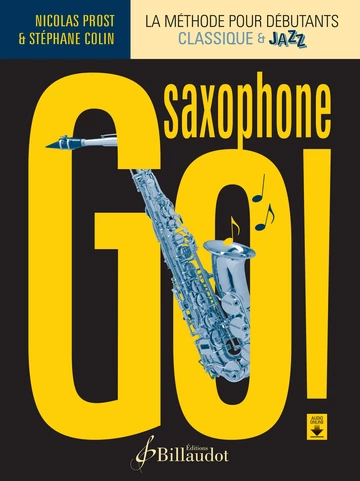
Saxophone Go !
méthode pour débutants - classique & jazz
Saxophone teaching continues to evolve in a modern world, where musical styles intersect and converge.
This method now illustrates that the saxophone cannot dissociate classical (melodic, scholarly, written music) and jazz (improvised music), thus allowing the budding saxophonist to free his musical voice thanks to his imagination and creativity.
Read moreDetails
| Instrument family | E-flat saxophone |
| Catalog classifications | Saxophone Methods |
| Instrument nomenclature | saxophone |
| Publisher | Éditions Billaudot |
| Cotage | GB10345 |
| Total number of pages | 56 |
| Languages | French |
| Cycle / Level | Beginner |
| Target audience | Adults, Children, Young people |
| Musical style | Classical, Jazz / Blues |
| Copyright year | 2022 |
| EAN code | 9790043103455 |
| Audios | on Education area, 2 Audio CDs on demand |
| Videos | Without |
| EDU complements | Without |

Description
Saxophone teaching continues to evolve in a modern world, where musical styles intersect and converge.
This method now illustrates that the saxophone cannot dissociate classical (melodic, scholarly, written music) and jazz (improvised music), thus allowing the budding saxophonist to free his musical voice thanks to his imagination and creativity.
In 20 lessons of two pages each (classical / jazz) covering a full year of learning, you will find all the tools necessary for precise and rapid progress thanks to varied instrumental technique exercises (sound, velocity, scales, etc.) accompanied by essential theoretical notions.
This course is completed by short pieces inspired by the “great arias” of classical music (Vivaldi, Mozart, Beethoven, Schubert, Bizet, Verdi, Debussy, etc.) giving an important cultural dimension to the method.
The introduction to jazz is done in parallel through original pieces or standards of all styles (Blues, Funk, Bossa Nova, Swing...) which follow the instrumental progression and which allow you to discover both the colors specific to each aesthetic, as well as to very gradually introduce yourself to improvisation.
The recordings made by a renowned trio — Benoît Sourisse (keyboards), Jean-Michel Charbonnel (double bass), André Charlier (drums) — allow the method to be used in complete autonomy.