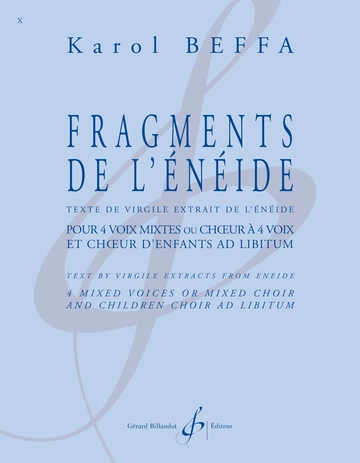
Fragments de l'Énéide
sur un texte de Virgile
Cette partition pour chœur a cappella ou quatuor de solistes et choeur d'enfants ad libitum, fut écrite en 2011, dans le cadre d’une mission pédagogique destinée à de jeunes collégiens qui n’avaient pas de culture musicale particulière, ne jouaient d’aucun instrument, et devait faire référence à l’Antiquité. Fragments de l’Enéide est construit en trois mouvements dont chacun dispose d’un élément structurant pour faciliter son apprentissage.
Read moreDetails
| Instrument family | Vocal music |
| Catalog classifications | Children’s choruses (4 voices and more) and piano |
| Instrument nomenclature | chœur à 4 voix et chœur d’enfants |
| Total duration | 00:09:00 |
| Publisher | Éditions Billaudot |
| Cotage | GB9333 |
| Total number of pages | 16 |
| Languages | French, English |
| Cycle / Level | Beginner, concert |
| Target audience | Children |
| Directory type | Original work(s) |
| Copyright year | 2012 |
| Année de composition | 2011 |
| EAN code | 9790043093336 |
| Audios | Without |
| EDU complements | Without |

Description
Written in 2011 as part of an educational project aimed at young middle school students without any prior musical training or any instrumental practice, this piece presented a special compositional challenge.
The project involved a targeted selection of about one hundred students from a ‘challenging’ middle school in the 12th arrondissement in Paris. Participation was on a voluntary basis, under the wing of their music teacher and their history teacher. The outcome of the project was to be a performance at the Salle Pleyel, together with the Orchestre de Paris Choir, conducted by Lionel Sow. As a composer, I had to comply with a certain number of (thematic as well as compositional) constraints, such as a reference to Antiquity, a period the children had studied in history class. I decided to choose excerpts from Virgil’s epic poem Aeneid and to keep to the original Latin text, as the language is easier to vocalize. The students’ total lack of musical experience created particular compositional constraints. The piece was to be a cappella: I wrote four parts (SATB) for the Orchestre de Paris (mixed) Choir and one single part for the young performers. Training them to sing two different parts was definitely not an option, neither musically nor time-wise. So I limited myself to one part for the young voices and, in order to make sure it would suit both the soprano and alto vocal ranges, kept the writing within the overlapping zones of the two registers.
The total duration of the piece could not exceed 10
minutes. I divided the composition in three well-contrasting movements so as to retain the young people’s attention and interest throughout.
Fragments de l’Énéide consists of three movements, each characterized by a distinctive element to facilitate learning. In the first movement, the children sing a long cantilena based on an unchanging rhythmic pattern before switching to the theme they have just heard repeated many times by the adult choir. The easy rhythm helps as a cue.
In the second movement, the children sing a six-measure foundational unit that repeats its pattern throughout various transpositions, first to D, then to G and finally to high D.
A little longer than the other two, the third movement is more meditative. Here, the danger lies in the singers’ intonation going flat. In order to solve this difficulty, three young performers are given bells, each sounding a particular pitch, respectively E, G and high E. On nine occasions, the choir director would cue one or the other ‘bell-ringer’ to sound his or her instrument. The knell1-like punctuation not only draws the young singers’ attention, it also helps them find their bearings in the score and prevents vocal fluctuations.
Incidentally, it was also a way to involve three rather assertive students whose voices were significantly changing, and have them take part in the premiere of the work (June 2012). At the time, the overall outcome of the experience was deemed ‘globally positive’. Musically speaking, the interpretation was fairly decent. While most people (teachers in particular) appreciated
the use of the original Latin text, officials from the board of education did not. They considered it a regressive approach that went against the educational trends they supported and promoted.
The part written for musically untrained middle-school students being ad libitum, Fragments de l’Énéïde is perfectly suitable for a cappella choirs or vocal quartets.
I wish to thank Latin-language expert Mathilde Lencou-Barême for her careful review of the text and her relevant comments on prosody.
Karol BEFFA
______________
The tolling refers to the famous hypallage: Ibant obscuri sola sub nocte per umbram